Alice Guy Blache by Emmanuelle Gaume with Alexandra Lamy

Alice Guy Blache by Emmanuelle Gaume with Alexandra Lamy
Affichage des articles dont le libellé est be natural the movie. Afficher tous les articles

lundi 17 juillet 2017

There was a Chilean girl named Alice Guy,,,Evening star. (Washington, D.C.) May 23, 1915– à Washington D.C. I-95.

There was a Chilean girl named Alice Guy, whose father was a publisher at Valparaiso. An earthquake ruined him,and lie died. Then Aliee Guy went toParis to live, with her mother and sister.When she was sixteen she studiedstenography, and got work in the oflicc of(iu/.ainont iV Co., Paris, producers of motion pictures. She heeame secretary to(iu/.amont, and one day said to him:"I don't like these pietures of trains andlire departments. Let me product4 someof the French short stories."l ltiinately she produced for him "ThePassion Play" and "Ksincralda," anddrew a salary of one thousand francs amonth. Then she married Herbert Ulachcand came with him to New York, wherehe represented (lu/.amont iV ('o.\ow Madame niacin1 had that spirit ofenterprise that gave her courage and impulse to work. She made a careful studyof the motion picture field in America,and asked, "Why can't I produce pictureshere on my o\\n account?"She looked around, and at Flushing,Long Island, she found a building thatwould answer for a studio. She rented it.She and her husl?and had ten thousanddollars between them, saved from theirsalaries, and tlii< became the capital ofMadame Blache in founding the Solax('ompany in I !MMl.Ulache still held his position. "1 willmanage tlii-; enterprise," said his wife.She went to work with vast energy. Firstshe studied her possible material, andread far into tlie night. Then she wroteher ow n scenarios and produced such pictures as "Fra Diavolo," "Carmen," Poe's"Pit and the Pendulum," and "Dick Whittington and llis Cat."The capital proved sufficient: for theprolits piled up fast. Three years ago theplant was moved to Fort Lee. New Jersey,and il is now a half-niillion-dollar eiitcrp?-i---. Madame Blaclie's productionsoften cn-t twenty thousand dollars. Thecompany's net profits are reputed to rangebetween lift ecu and twenty thousand dollars a nionth. Evening star. (Washington, D.C.) May 23, 1915– à Washington D.C. I-95.
https://www.facebook.com/aliceguyblache/

samedi 11 mars 2017

Pasión por Alice Guy, la primera visionaria Figura completamente esencial en el nacimiento del arte cinematográfico,

Pasión por Alice Guy, la primera visionaria Figura completamente esencial en el nacimiento del arte cinematográfico, Alice Guy (1873-1968) representa además un caso paradigmático de la invisibilidad a la cual han sido sometidas las mujeres en las historias canónicas del cine.


Primera cineasta de la historia, dirigió su primer film, La Fée aux Choux, en 1896, a escasas semanas de primera exhibici
ón pública del cinematógrafo de los hermanos Lumière. Considerado como una de las primeras expresiones de cine explícitamente narrativo, el mismo fue producto de la concepción pionera de Alice, una adelantada a su tiempo.

                                                                        Sin dudas el destino de la artista quedó marcado a fuego cuando a sus 21 años, el 22 de marzo de 1895, asistió en carácter de secretaria de Léon Gaumont a la primera demostración de la flamante invención de los hermanos Lumière, el cinematógrafo. Entusiasta desde ese minuto cero, fue la primera persona que vio al cine no como una simple herramienta científica o un divertimento de feria, sino como un verdadero medio de expresión artística, que no tenía nada que envidiarle a la literatura o el teatro. Visionaria, convenció a su jefe de redireccionar la empresa Gaumont, centrada originalmente en la fotografía fija, a la realización de imágenes en movimiento. Su jefe, inicialmente no muy convencido del nuevo invento, tuvo sin embargo la sabiduría de colocar a Alice al frente de ese nuevo proyecto. En tiempos donde los roles aún no tenían un nombre específico, Alice Guy creó el concepto y se convirtió en la primera jefa de producción de la historia, una de las tantas innovaciones que introduciría en la industria.

Las cifras son muy contundentes: Alice Guy dirigió por lo menos 700 películas (hay fuentes que señalan que la cifra supera las 1000) y produjo y escribió otros cientos más. Formó además a toda una generación de realizadores que la sucederían, entre los que se destacó Louis Feuillade, otro de los visionarios pioneres. En 1907, cuando Hollywood aun no existía, emigró a EE.UU. y fundó su propia productora, la Solax Film Co. Comprometida ideológicamente con el rol de las mujeres en el nuevo medio, en 1913 escribió un revelador artículo titulado “Woman's Place in Photoplay Production”, en el que denunció que la expansión del cine como industria comercial estaba llevando a la vulgarización del medio, por lo que era necesario el aporte urgente de las mujeres para revertir tal situación. Años antes, en 1906, había realizado Les résultats du féminisme, un adelantado cortometraje que desde la lúdica e irreverente inversión de roles buscó dejar en evidencia la matriz machista y patriarcal de la sociedad. Verdadera innovadora, introducía la palabra feminismo en el cine, cuando este era aún un concepto muy nuevo en la sociedad.


Debido a la desfortuna de las preservación cinematográfica, solo una parte de la inmensa producción de Alice se encuentra disponible en la actualidad, pero la misma ofrece sorpresas mayúsculas. Por ejemplo, su revelador film Alice Guy tourne une phonoscène (1905) nos permite verla en el set de rodaje, dirigiendo la puesta en escena, en lo que constituye en el primer making-off de la historia del cine. Notoria creadora de conceptos, su filmografía también nos permite evidenciar su profunda sensibilidad estética, nunca desatendida a pesar de lo prolífico de su producción

Ignorada durante más de un siglo por las historias canónicas —el caso más irritante es el de Roman Gubern, que en la edición 2014 de su afamada Historia del Cine le sigue dedicando apenas un (misógino) párrafo, en el que la reduce a "la secretaria de Gaumont"—, solo recientemente la figura de Alice Guy comenzó a tomar resonancia gracias a las valiosas investigaciones de distintas académicas comprometidas en comprender la historia del cine por afuera de las concepciones machistas.


Genia y visionaria, Alice Guy no fue solo la primera cineasta, sino también la primera persona cinéfila de la historia, la primera que comprendió a la emoción como el motor verdadero del medio. Todos los que amamos el cine le debemos mucho y es hora que la posicionemos como la figura esencial que nunca tendría que haber sido puesta en duda, a la par de los Lumière y Georges Méliès.

Publicación: Marzo 2016 por Sebastián Santillán http://www.marienbad.com.ar/articulo/alice-guy-la-primera-visionaria

vendredi 17 février 2017

Dancing with Alice Guy-Blaché


Dancing with Alice Guy-Blaché

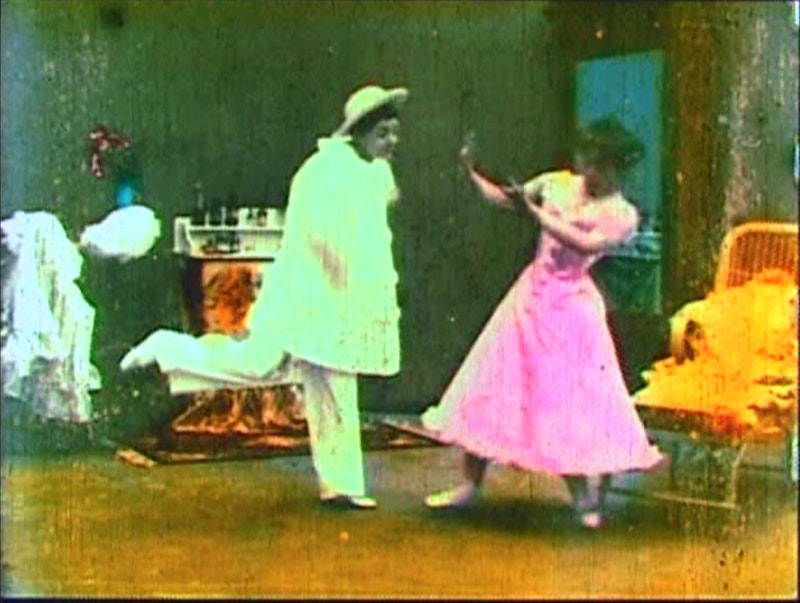
The first female director’s tinted silent film, Pierette’s Escapades.
Pierrettes escapades.jpg?ixlib=rails 2.1
Alice Guy-Blaché used to tell her actors, “Be natural.” It’s advice that rings oddly when you watch her films. Guy-Blaché was the first woman director, and to modern eyes her silent films look stagey and highly artificial. Actors mime broadly as they trot through unlikely scenarios. Women get glued to stairwells, babies are born from cabbages, statues come to life. There’s a lot of slapstick and fantasy. It can be surprisingly entertaining, but it’s not what you’d call realistic.
One of Guy-Blaché’s least naturalistic films is Pierrette’s Escapades, a 1900 two-minute short. Most of Guy-Blaché’s films are black and white, but Pierrette’s Escapades is vibrantly hand-tinted. The main character, a young woman dancing in her room, wears a bright pink desk; a chair off to the side is a vivid and incongruous yellow/orange, while a dresser in the back pops red. Black-and-white images, these days, usually indicate grit and realism; the brightness of Pierrette’s Escapades makes the film seem hyper-real and fantastic—a window onto a kind of fairyland.
The narrative, such as it is, is fantastical too. The woman protagonist is in her own room, dancing for no one, or herself, or the audience, when she’s accosted by an androgynous individual in a hat and oversized white coat, who tries to kiss her. She dodges his advances, and shows him out. Then she twirls about some more, lifting her skirts flirtatiously, until another woman dressed as a man in shining green tights and yellow boots appears. The two of them dance, the green woman’s arm around the pink woman’s waist, and then delightedly kiss, at which point the film ends.
In “Comparative Sapphism,” Sharon Marcus argues that in France in the 1800s lesbianism was associated with the seamy underbelly of life—French novelists showed they were mired in authentic nastiness by exploring taboo topics like drug abuse, violence, and homosexuality. But that’s obviously not what’s happening here. The flirtations with androgyny and lesbian eroticism aren’t presented as dirty, real, or tragic in Guy-Blaché’s film. On the contrary, lesbianism here is theatrical, light-hearted, campy fun. It’s fluffy diversion.
Who’s fluffily diverted, though? We don’t know a lot about the audience or genres of early silent film, and it’s difficult to reconstruct exactly what Guy-Blaché thought she was saying, or to whom. We know broadly that Pierrette’s Escapades draws the Harlequinade, of the Comedia d’elle arte tradition. Harlequin farces often included cross-dressing and pantomime; women often played young boys, while men played ugly old women. In harlequin performance, the story of Pierrot (here feminized to Pierrette) was about unrequited love, with Pierrot pursuing a woman named Columbine futilely, to evoke either pathos or ridicule.
That simple outline leaves questions for those watching Pierrette’s Escapades today. First, why has Pierrot been changed to Pierrette? Is the Pierrette figure supposed to be a man? A woman? Is the gender deliberately ambiguous? Was the audience supposed to find the lesbian romance funny? Disturbing? Arousing? Maybe Guy-Blaché made the movie for a primarily male audience, fitting broadly into a tradition of porn for men featuring lesbian eroticism. Maybe it was for a female audience, in which case perhaps women at the time found female/female relationships funny or titillating.
Another mysterious aspect of the film is the setting. Where’s the film supposed to be taking place? Is Columbine an actress or dancer, waiting in her room backstage? Is she in her own room? The set is framed as an interior; Columbine is in her room, with her own make-up table, and a mirror before which she primps and dances. But you can’t see any doors. Columbine’s first suitor simply walks on. The second appears in the center of the floor as if by magic; there must be a break in the version of the film extant, so that her exact moment of arrival is lost.
The location of the film is ill-defined because Pierrette’s Escapades is not a narrative or a story. The point of the film is simply to show Columbine, an attractive woman, dance, reject one suitor, and embrace a second. There’s no development; it’s simply spectacle. The film makes little effort to be natural; it has no pretense of realism. As such, it’s arguably more natural than the standard contemporary Hollywood film that presents itself as a window on an ongoing reality. Guy-Blaché’s film is open about its artificiality; it’s natural in that it admits it’s not natural. It’s taking place in a place that is not a place, in brilliant colors that are not colors.
This is the pleasure of the film. The short pantomime isn’t tied down by any logic, colors or narrative. Natural rules about gender and sexuality are casually shrugged off; people of every gender, or none, watch and admire Columbine. The film frame doesn’t take you to a real place. Instead, it’s a magical, flickering vision, in which people and desires appear and disappear. http://splicetoday.com/moving-pictures/dancing-with-alice-guy-blache


https://www.youtube.com/watch?v=dvDfacxx6gs

mercredi 4 janvier 2017

Alice Guy Blache ©riginal Solax & Be Natural™


#Alice Guy Blache ©riginal -Solax & Be Natural™1910
Alice Guy Blache ©riginal Solax & Be Natural™ 


Alice Guy Blache ©riginal Solax & Be Natural™


Alice Guy Blache ©riginal Solax & Be Natural™
http://archive.org/stream/movingpicturewor12newy#page/1006/mode/2up
MR. H. BLACHE SEVERS HIS CONNECTION WITH GAUMONT CO. We are in receipt of a communication from Mr. Herbert Blache, who was formerly general manager and vice-president of the Gaumont Company, with offices and studio at Flush- ing, L. I ..

samedi 16 avril 2016

A TERRIBLE LESSON" (Solax). Frank Chance Darwin Karr His Wife Blanche Cornwall His Friend Billy Quirk The Owner of the Gambling Den Lee Beggs f those who are inveterate gamblers could be brought to .. *Be Natural ©riginal story of Alice Guy by Alice Guy Blaché

mercredi 30 mars 2016

The Girl in the Arm-Chair by Alice Guy Blache

THE GIRL IN THE ARM CHAIR" Featuring Darwin Kerr Solax Release Dec. 13th A girl sitting in a large armchair hears the man she loves planning to rob his father to pay some I. O. U .... by Alice Guy Blaché

samedi 7 mars 2015

* Be Natural ©riginal Alice Guy Blaché as Producer and Director for Solax Co.

1.
* Be Natural ©riginal  Alice Guy Blaché as Producer and Director for Solax Co.
Alice Guy Blaché as Producer and Director for Solax Co.

A Child’s Sacrifice, 1910; A Fateful Gift, 1910; Her Father’s Sin, 1910; Lady Betty’s Strategy, 1910; Mrs Richard Dare, 1910; One Touch of Nature, 1910; The Pawnshop, 1910; The Sergeant’s Daughter, 1910; Two Suits, 1910; What is to Be, Will Be, 1910; A Widow and Her Child, 1910; Across the Mexican Line, 1911; All Aboard for Reno, 1911; The Altered Message, 1911; Baby Needs Medicine, 1911; Baby’s Choice, 1911; Baby’s Rattle, 1911; The Bachelor’s Housekeeper, 1911; A Bad Egg, 1911; Beneath the Moon, 1911; The Best Policy, 1911; Between Life and Death, 1911; A Breezy Morning, 1911; Bridget the Flirt, 1911; A Bum and a Bomb, 1911; Caribou Hunting, 1911; Corinne in Dollyland, 1911; A Corner in Criminals, 1911; A Costly Pledge, 1911; The Count of No Account, 1911; Cupid and the Comet, 1911; Cupid’s Victory, 1911; A Daughter of the Navajo, 1911; Deaf and Dumb, 1911; The Devil in a Tin Cup, 1911; The Divided Ring, 1911; The Double Elopement, 1911; The Fascinating Widow, 1911; Fickle Bridget, 1911; Following Cousin’s Footsteps, 1911; For Big Brother’s Sake, 1911; A Gay Bachelor, 1911; The Girl and the Bronco Buster, 1911; The Girl and the Burglar, 1911; Grandmother Love, 1911; Hector’s Inheritance, 1911; Her Uncle’s Will, 1911; A Heroine of the Revolution, 1911; Highlands of New Brunswick, Canada, 1911; A Hindu Prince, 1911; His Best Friend, 1911; His Better Self, 1911; His Mother’s Hymn, 1911; His Sister’s Sweetheart, 1911; His Wife’s Insurance, 1911; The Hold-Up, 1911; The House of Peace, 1911; How Hopkins Raised the Rent, 1911; Husbands Wanted, 1911; In the Nick of Time, 1911; An Interrupted Elopement, 1911; An Italian’s Gratitude, 1911; Johnnie Waters the Garden, 1911; Let No Man Put Asunder, 1911; Life on Board a Battleship, 1911; The Little Flower Girl, 1911; The Little Kiddie Mine, 1911; The Little Shoe, 1911; Love, Whiskers, and Letters, 1911; A Lover’s Ruse, 1911; Love’s Test, 1911; A Maid’s Revenge, 1911; Marked for Life, 1911; A Marvelous Cow, 1911; A Mexican’s Girl’s Love, 1911; A Midnight Visitor, 1911; The Mill of the Gods, 1911; Naval Review, 1911; Nearly a Hero, 1911; Nellie’s Soldier, 1911; Never Too late to Mend, 1911; The Nightcap, 1911; An Officer and a Gentleman, 1911; Oh! You Stenographer!, 1911; The Old Excuse, 1911; Out of the Arctic, 1911; Out of the Depths, 1911; A Package of Trouble, 1911; The Patched Shoe, 1911; The Paper Making Industry, 1911; Percy and His Squaw, 1911; The Phony Ring, 1911; Put Out, 1911; A Reporter’s Romance, 1911; A Revolutionary Romance, 1911; Ring of Love, 1911; The Rose of the Circus, 1911; Salmon Fishing in Canada, 1911; The Scheme that Failed, 1911; Sensible Dad, 1911; Sergeant Dillon’s Bravery, 1911; Sergeant Mann’s Bravery, 1911; She Was Not Afraid, 1911; The Silent Signal, 1911; The Somnambulist, 1911; Starting Something, 1911; A Terrible Catastrophe, 1911; That June Bug, 1911; Their First Baby, 1911; Tramp Strategy, 1911; A Troublesome Picture, 1911; The Violin Maker of Nuremberg, 1911; The Voice of His Conscience, 1911; When Reuben Came to Town, 1911; The Will of Providence, 1911; At the Phone, 1912; Auto-Suggestion, 1912; The Bachelor’s Club, 1912; Bessie’s Suitors, 1912; Between Two Fires, 1912; Billie’s Troublesome Grip, 1912; Billy Boy, 1912; Billy, the Detective, 1912; Billy’s Insomnia, 1912; Billy’s Nurse, 1912; Billy’s Shoes, 1912; Black Sheep, 1912; Blighted Lives, 1912; The Blood Stain, 1912; The Boarding House, 1912; Bottles, 1912; Buddy and his Dog, 1912; By the Hand of a Child, 1912; The Call of the Rose, 1912; The Child of the Tenements, 1912; Count Henri, The Hunter, 1912; Mrs. Cranston’s Jewels, 1912; The Dog-Gone Question, 1912; Economical Brown, 1912; The Face at the Window, 1912; Father and the Boys, 1912; The Finger Prints, 1912; The Fixer Fixed, 1912; Flesh and Blood, 1912; The Flour Flush Actor, 1912; Four Friends, 1912; Frozen on Love’s trail, 1912; The Fugitive, 1912; The Glory of Light, 1912; God Disposes, 1912; The Gold Brick, 1912; The Great Discovery, 1912; A Guilty Conscience, 1912; Handle with Care, 1912; The Hater of Women , 1912; Hearts Unknown, 1912; His Lordship’s White Feather, 1912; His Musical Soul, 1912; Hotel Honeymoon, 1912; Hubby Does the Washing, 1912; The Idol Worshipper, 1912; Imagination, 1912; In the Year 2000, 1912; Indian Summer, 1912; The Jenkins-Perkins War, 1912; Just a Boy, 1912; Just Hats, 1912; The Knight in Armor, 1912; The Legend of the Balanced Rock, 1912; Lend Me Your Wife, 1912; The Life of a Rose, 1912; The Little Soldier, 1912; Love’s Railroad, 1912; The Maverick, 1912; Memories of ’49, 1912; Mignon, 1912; The Old Violin, 1912; Open to Proposals, 1912; Our Poor Relations, 1912; The Paralytic, 1912; Phantom Paradise, 1912; The Pink Garters, 1912; Planting Time, 1912; Playing Trumps, 1912; The Power of Money, 1912; The Prodigal Wife, 1912; A Question of Hair, 1912;The Raffle, 1912; The Reformation of Mary, 1912; The Report From Eden, 1912; The Requital, 1912; Riding Feats of the 15th Cavalry, 1912; Saved by a Cat, 1912; Sealed Lips, 1912; Slippery Jim, 1912; Si’s Surprise Party, 1912; The Snowman, 1912; The Soul of The Violin, 1912; Souls in the Shadow, 1912; The Spry Spinsters, 1912; A Terrible Lesson, 1912; Treasures on the Wing, 1912; Winsome But Wise, 1912; The Wise Witch of Fairyland, 1912; The Woman Behind the Man, 1912; The Wonderful Oswego Falls, 1912; The Wooing of Alice, 1912; The Amateur Highwayman, 1913; The Bachelor’s Housekeeper, 1913; The Bashful Boy, 1913; Burstop Holmes, Detective, 1913; Canine Rivals, 1913; The Case of the Missing Girl, 1913; The Climax, 1913; Cousins of Sherlock Holmes, 1913; Dad’s Orders, 1913; The Eyes of Satan, 1913; The Henpecked Burglar, 1913; His Son-in-Law, 1913; His Wife’s Affinity, 1913; In the Wrong Flat, 1913; The King’s Messenger, 1913; The Kiss of Judas, 1913; The Lady Doctor, 1913; The Man in the Sick Room, 1913; The Man who Failed, 1913; A Million Dollars, 1913; The Monkey Accomplice, 1913; Mother and Daughter, 1913; The Mutiny of Mr. Henpeck, 1913; The Mystery of the Lost Cat, 1913; The Ogres, 1913; Overcoats, 1913; The Past Forgiven, 1913; The Plan of the House, 1913; The Quarrelers, 1913; The Rogues of Paris, 1913; The Scheming Woman, 1913; A Severe Test, 1913; The Silver Cross, 1913; Till the Day Breaks, 1913; The Way of the Transgressor, 1913; Where Love Dwells, 1913; The Wrong Box, 1913.

lundi 5 janvier 2015